Subway Surfers is an exciting endless runner where you dodge trains, collect coins, use power-ups, and run as far as possible without getting caught.
Ball Surfer 3D is an endless rolling game where you steer a ball, avoid obstacles, collect gems, use power-ups, and race farther for a higher score.
Run 3 is a fast-paced space adventure where you guide an alien through tunnels, dodge gaps, unlock new characters, and explore challenging game modes.
Swagflip brings fast parkour action as you master backflips, avoid obstacles, and land safely while chasing higher scores and stylish stunts.
Victory Lap Dash challenges players to guide Geometry through fast platform levels, master precise timing, dodge obstacles, and improve with every attempt.
I Just Might Dash is a colorful Geometry Dash game that tests your timing with tricky obstacles, exciting backgrounds, Practice Mode, and Normal Mode.
How to Play Geometry Dash Wave Challenge
Controls
- Click the left mouse button to make the wave fly upward. Release the button to let it fly downward.
- Press Z to place a checkpoint in Practice Mode.
- Press X to remove the most recently placed checkpoint.
Your Main Objective
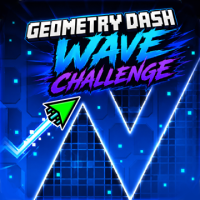
The goal in this fast-paced game is to guide the wave safely from the beginning of each level to the finish line without touching any obstacle. Even a slight collision with a spike, wall, ceiling, or floor ends your current attempt instantly. Unlike traditional platformers that reward exploration, this game is entirely about maintaining smooth movement through narrow zigzag corridors. Each completed level prepares you for the next one by introducing more complex layouts and tighter spaces.
Tips and Tricks for Geometry Dash Wave Challenge
Mastering Geometry Dash Wave Challenge takes more than fast reactions. Learning how the levels are designed will help you improve much faster than simply restarting over and over.
Complete the Maps in Order
Although all four levels are available, it is highly recommended to play them sequentially. The first three maps gradually introduce the mechanics you will need later. Map 1 teaches basic wave control inside wide corridors. Map 2 introduces size-changing portals, while Map 3 trains you to fly through funnel-shaped formations. By the time you reach Map 4, you will already recognize every obstacle type. The final level simply combines everything you have learned into one longer challenge instead of introducing completely new mechanics.
Practice Mode First
Practice Mode is one of the most useful features in Geometry Dash Wave Challenge. Instead of restarting from the beginning after every mistake, you can place checkpoints anywhere by pressing Z. If you crash, you will immediately respawn at the latest checkpoint, allowing you to practice difficult sections repeatedly. The game also helps beginners by automatically creating checkpoints if you don't have enough time to place them yourself. This lets you focus on learning obstacle patterns rather than worrying about checkpoint timing. Once you can complete every section consistently in Practice Mode, switch to Normal Mode and attempt a full run without checkpoints.
Master Micro-Clicking
One of the most valuable techniques is micro-clicking. Rather than holding the mouse button for long periods, use very short, rapid clicks to keep the wave centered inside narrow tunnels. This produces smaller movements and makes it much easier to avoid both the ceiling and the floor. This technique becomes especially important during the tight zigzag sections found later in the game, where even a tiny overcorrection can end your run.
Watch the Center Instead of the Spikes
Many beginners constantly look at the spikes in front of them. A better approach is to focus on the empty path between the obstacles. Keeping your attention in the middle of the corridor makes your movements smoother and reduces unnecessary corrections. Over time, you will naturally memorize the rhythm of each section instead of reacting to every individual spike.
Popular Challenges in Geometry Dash Wave Challenge
Narrow Zigzag Corridors
The most common challenge is flying through alternating spikes attached to both the ceiling and the floor. These obstacles create continuous zigzag passages that require you to constantly alternate between climbing and descending. Since the wave always travels diagonally, every click must be carefully timed to avoid touching either side of the corridor. As the levels progress, these passages become noticeably tighter, leaving very little room for mistakes.
Size-Changing Portals
Another challenge appears when the wave passes through portals that change its size. A smaller wave can fit through tighter spaces, but it also feels more sensitive to every click. Players who continue using the same clicking rhythm often overcorrect after shrinking. The key is to stay calm and make slightly smaller adjustments until you become comfortable with the new size.
All the available maps in this game
Geometry Dash Wave Challenge currently features four levels with increasing difficulty. Each map introduces new mechanics while building upon the skills learned in previous stages.
Map 1
Map 1 is the easiest level and serves as an introduction to the game's controls. The zigzag corridors are wide, the spikes are spaced far apart, and there are very few sudden direction changes. New players can use this level to understand how different click lengths affect the wave's movement without being heavily punished for small mistakes.
Map 2
Map 2 remains beginner-friendly but introduces a new gameplay mechanic: the size-changing portal. After passing through the portal, your wave becomes smaller. This actually makes it easier to squeeze through narrow openings, although the movement may initially feel more sensitive. The main purpose of this level is helping players become comfortable with portal transitions before facing more demanding obstacle layouts.
Map 3
Map 3 is much shorter than the previous stages and usually takes only seven to eight seconds to complete. Instead of using large triangular blocks, this level creates funnel-shaped corridors using rows of increasingly larger spikes. The safest strategy is to keep your wave near the center of the tunnel instead of flying close to either wall. Maintaining a stable rhythm is much more effective than making large corrections whenever the corridor narrows.
Map 4
Map 4 is where the real Geometry Dash Wave Challenge begins. This level combines nearly every obstacle introduced earlier, including narrow zigzag corridors, funnel-shaped spike formations, and size-changing portals. It is also noticeably longer than the previous maps, taking roughly 20 to 25 seconds to finish. Although the level is more demanding, it doesn't introduce completely new mechanics. Success depends on how well you've mastered the first three maps and whether you can maintain consistent control throughout the entire run.
Geometry Dash Wave Challenge vs. Geometry Dash
Similarities
Both games belong to the fast-paced platform genre and reward precise timing over random reactions. Players control geometric characters while avoiding deadly obstacles, and a single mistake immediately restarts the attempt. They also include both Normal Mode and Practice Mode, allowing players to learn difficult sections with checkpoints before attempting a full completion.
Differences
The biggest difference is movement.
In Geometry Dash, your character changes between several forms such as Cube, Ship, Ball, UFO, Robot, Spider, and Wave by passing through portals. Each form follows different movement rules. Geometry Dash Wave Challenge removes all of these transformations and focuses exclusively on the Wave mechanic. Since you only use one movement style throughout the game, every level emphasizes precision rather than adapting to different forms.
Another major difference is collectibles.
Traditional Geometry Dash levels hide three secret coins that encourage exploration and optional challenges. Geometry Dash Wave Challenge contains no collectible coins, so the only objective is reaching the finish line as cleanly as possible.
Level length is also significantly different.
A standard Geometry Dash level often takes around one and a half to two minutes to complete, while most maps in Geometry Dash Wave Challenge can be finished in about 15 to 25 seconds. This shorter format makes it ideal for quick practice sessions and repeated attempts.
FAQ About Geometry Dash Wave Challenge
Is Geometry Dash Wave Challenge difficult?
Not particularly. The game is much easier than many official Geometry Dash Demon levels because it focuses on only one movement mechanic. Most players can improve quickly after spending some time in Practice Mode, while experienced Geometry Dash players may even clear every level on their first attempt.
Does Geometry Dash Wave Challenge provide skins?
Yes. The game includes multiple skins that you can freely choose from. Unlike the original Geometry Dash, you don't need to collect stars or complete achievements to unlock them, allowing you to customize your wave immediately.
How many levels are available?
There are currently four playable levels ranging from easy to harder difficulty. According to the game's information, two additional and more challenging levels are planned for future updates.
Which devices can run Geometry Dash Wave Challenge?
Geometry Dash Wave Challenge runs directly in a web browser, so you can play it on desktop computers, laptops, tablets, and most modern smartphones. As long as your device has a stable internet connection and an up-to-date browser, you can start playing without downloading or installing anything.