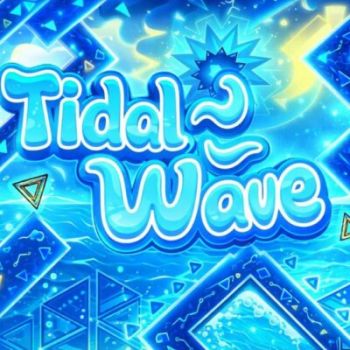
How to Play Geometry Dash Tidal Wave
Basic Controls
- Click the left mouse button on the PC.
- Tap the screen on mobile devices.
Your Goal
The objective in Geometry Dash Tidal Wave is straightforward: guide the Wave from the beginning of the level to the finish line without touching any obstacle.
Every spike, wall, ceiling, and platform is deadly. A single collision instantly restarts the level, so success depends on maintaining perfect rhythm from start to finish.
Unlike traditional platform games that reward exploration, this game is entirely focused on mechanical execution. The better your timing and muscle memory become, the farther you will progress.
Learn the Rhythm Instead of Reacting
Many new players try to react to every obstacle individually. That approach rarely works because the Wave moves too quickly.
Instead, memorize short sections of the level. Once you know where each climb and descent should happen, your movements become much more consistent. This is why experienced Geometry Dash players often complete difficult levels through repetition rather than fast reactions alone.
Why Geometry Dash Tidal Wave Is So Difficult
Geometry Dash Tidal Wave has earned its reputation because it constantly demands precision without giving players much room for error.
Extremely Tight Wave Corridors
Most of the level consists of narrow zigzag tunnels where the Wave must stay almost perfectly centered.
Even slightly overholding or releasing the mouse too early can send the Wave into a spike. As the corridors become tighter, small mistakes become impossible to recover from.
High-Speed Gameplay
The movement speed leaves little time to think about upcoming obstacles.
Instead of reacting after seeing a hazard, players must already know the next movement before reaching it. This creates a gameplay style that rewards memorization as much as quick reflexes.
Continuous Focus
Some difficult platform games include slower moments that allow players to relax.
Geometry Dash Tidal Wave rarely offers those breaks. Every second requires concentration, making mental endurance just as important as mechanical skill.
Geometry Dash Wave Challenge vs. Geometry Dash Tidal Wave
Although both games focus heavily on Wave gameplay, they are designed for very different audiences.
The biggest difference is difficulty.
Geometry Dash Wave Challenge is designed as a training experience. It introduces Wave mechanics through four short levels that gradually become harder. Most players can improve quickly because the obstacles are presented in a logical progression.
Geometry Dash Tidal Wave is much less forgiving. It assumes players already understand advanced Wave control and immediately presents precise corridors that require excellent timing.
Level Design
Geometry Dash Wave Challenge separates different mechanics into individual maps. One level focuses on basic zigzags, another introduces portals, while the final stage combines everything together.
Geometry Dash Tidal Wave does not follow that learning curve. Difficult patterns appear throughout the level, requiring players to adapt immediately instead of learning one mechanic at a time.
Length
Wave Challenge contains several short stages that can usually be completed within seconds.
Geometry Dash Tidal Wave is considerably longer, meaning players must maintain consistent accuracy for a much longer period. A single mistake near the end still sends you back to the beginning.
Best Players for Each Game
If you have never practiced Wave movement before, Geometry Dash Wave Challenge is the better starting point.
If you already feel comfortable controlling the Wave and want a much greater challenge, Geometry Dash Tidal Wave offers a far more demanding experience that tests nearly every aspect of your precision.
Can New Geometry Dash Players Start with Geometry Dash Tidal Wave?
The short answer is probably not, especially if this is your first Geometry Dash game.
The Learning Curve Is Very Steep
Unlike beginner-friendly Geometry Dash levels that slowly introduce mechanics, Geometry Dash Tidal Wave expects players to already have solid Wave control.
New players often struggle to survive even the opening sections because they have not yet developed the muscle memory needed for constant 45-degree movement.
This doesn't mean beginners cannot play it, but they should expect frequent restarts and slow progress.
Build Fundamental Skills First
A better approach is to spend time learning the basic mechanics before attempting this level.
Playing easier Wave-focused levels teaches important skills such as controlling height, maintaining rhythm, and making tiny directional adjustments. Once these become automatic, returning to Geometry Dash Tidal Wave feels much more manageable.
Progress Through Practice
Improvement comes from consistency rather than speed.
Instead of trying to complete the entire level immediately, focus on mastering one section at a time. After repeating each segment enough times, you'll naturally begin linking them together into longer successful runs.
Even experienced Geometry Dash players often spend many attempts practicing difficult parts before finally achieving a complete run.
Why Geometry Dash Tidal Wave Is Popular
Geometry Dash Tidal Wave has become one of the most recognized community-inspired challenges because it represents an exciting goal for players who enjoy improving their skills.
Its demanding Wave gameplay encourages precision, patience, and perseverance. Every successful attempt feels rewarding because progress is earned through practice rather than luck.
Whether you're trying to survive the opening corridors or aiming for a complete clear, Geometry Dash Tidal Wave provides an intense experience that showcases just how deep the Wave mechanic can be.