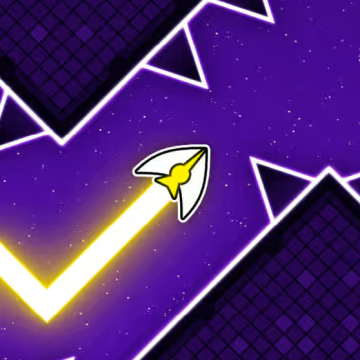
How to Play Space Waves?
Basic controls
- Click the left mouse button or tap on the screen to fly.
- Release to drop.
Master the wave movement
Unlike many platform games that rely on jumping, Space Waves uses smooth wave motion. Small adjustments often produce better results than holding the button for too long. Gentle taps help you stay centered and react quickly when narrow passages appear.
Practice makes perfect
The first few attempts may seem difficult, especially on complex stages. However, every restart helps you remember obstacle locations and improve your timing. Over time, your reactions become faster, making previously difficult levels feel much easier. Players who enjoy this wave-style gameplay should also explore Geometry Dash Wave Challenge. It features a similar control system while offering unique level designs, making it an excellent choice for anyone wanting to sharpen their precision before returning to Space Waves.
Reach the Goal to Complete Every Level
Each level in Space Waves has a single objective: reach the destination without crashing. Unlike games that require collecting items or defeating enemies, success depends entirely on your ability to survive the journey. Every obstacle is carefully placed to test your control, forcing you to react quickly and maintain accurate movement from start to finish.
Every level introduces new patterns
As you progress through Space Waves, the layouts become increasingly creative. Some levels contain long, open corridors that encourage smooth movement, while others are packed with tight spaces requiring extremely accurate control. The changing environments prevent the gameplay from becoming repetitive. Every new level introduces fresh challenges that encourage players to adapt instead of relying on the same strategy.
Learn from every restart
Restarting is part of the experience in Space Waves. Instead of treating failure as punishment, the game encourages players to memorize obstacle positions and improve with each attempt. After several runs, many difficult sections become much easier because you begin anticipating hazards before reaching them.
Does Your Character Have Lives or a Time Limit?
One of the most welcoming features of Space Waves is its forgiving progression system.
No lives
There is no life system. You never need to worry about running out of attempts or waiting to continue playing. Whenever your wave collides with an obstacle, the current level immediately restarts from the beginning. This quick reset keeps the gameplay fast and minimizes downtime between attempts.
No time limit
Space Waves also removes the pressure of countdown timers.
Players are free to complete each level at their own pace. You can pause briefly before entering difficult sections, carefully plan your movements, and focus entirely on avoiding obstacles instead of racing against the clock. This design makes Space Waves enjoyable for beginners while still providing enough challenge for experienced players who want to improve their completion times.
Challenges Players Face Along the Way
Although the controls are easy to learn, Space Waves becomes increasingly demanding as players advance through the game.
Narrow passages
Many levels contain extremely tight corridors where even the smallest mistake results in a collision. Accurate movement and steady hands are essential to survive these sections.
Sharp corners
Some obstacles require sudden changes in direction. Reacting too early or too late often leads to failure, making timing one of the most important skills in Space Waves.
Continuous obstacle patterns
Several stages combine multiple hazards into long sequences. Players must maintain concentration for extended periods without making a single mistake.
Increasing speed
As the difficulty increases, some levels feel much faster because obstacle spacing becomes tighter and reaction windows narrow. Remaining calm helps you maintain better control even when the action becomes intense.
Maintaining focus
One of the biggest challenges in Space Waves is staying focused after repeated restarts. Since a single collision sends you back to the beginning, patience becomes just as important as quick reflexes.
Tips to Improve Your Performance
Use short taps
Avoid holding the button for too long. Short, controlled taps allow smoother movement and make it easier to navigate tight spaces.
Watch ahead
Instead of focusing only on your current position, look farther down the path. Anticipating upcoming obstacles gives you more time to react.
Stay relaxed
Panicking usually leads to unnecessary mistakes. Keeping a steady rhythm helps maintain consistent control throughout the level.
Learn difficult sections
Every failed attempt provides valuable information. Remembering the positions of obstacles helps you build muscle memory and gradually complete even the hardest stages.