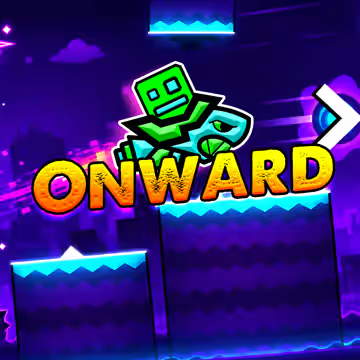
How to Play Geometry Dash Onward?
Click or Press the Spacebar to Play
To control the character in Geometry Dash Onward, click the left mouse button or press the Spacebar to play. These inputs allow you to perform the main action required to move through the level.
The most important part is not the number of times you press the button but when you press it. A well-timed jump can help you clear a row of spikes, land safely on a platform, or pass through a difficult section.
Avoid clicking randomly. Instead, watch the character's position and look ahead at the upcoming obstacles. With practice, you can develop a rhythm that makes your movements more consistent.
Use Z and X for Checkpoints
Geometry Dash Onward also provides checkpoint controls that can make difficult sections easier to practice.
Press Z to place a checkpoint and X to delete checkpoints.
Checkpoints are especially useful when you are learning a difficult part of the level. Rather than restarting from the beginning every time you make a mistake, you can practice a specific section and focus on improving your timing.
Use checkpoints as a learning tool rather than simply relying on them to finish the level. Once you become comfortable with a difficult section, try completing it from the beginning without depending on a checkpoint.
Experience the Difficult Challenges in the Game
Geometry Dash Onward becomes increasingly demanding as you progress through its levels. The game combines fast movement, dangerous obstacles, good visual effects, and character transformations to create sections that require constant concentration.
The difficulty does not come from complicated controls. Instead, it comes from having to use simple controls under increasingly demanding conditions.
Sharp Spikes Along the Path
Sharp spikes are one of the most recognizable dangers in Geometry Dash Onward. They can appear individually, in groups, or as part of larger obstacle patterns.
A single mistake can cause an immediate collision, so you need to judge the distance between your character and each spike carefully.
Time Your Jumps
Jumping over spikes requires accurate timing. If you jump too early, you may land directly on another spike. If you wait too long, your character may collide with the obstacle before leaving the ground.
Try to identify the rhythm of a spike sequence rather than reacting separately to every spike. Once you learn the pattern, your movements become more predictable.
Watch for Unexpected Combinations
Spikes may appear together with platforms, gaps, or other hazards. A jump that clears one obstacle may create another problem if you do not consider where the character will land.
Always think about the complete movement: where you start, what you need to clear, and where you will land.
Flashing Colors Make the Path Harder to See
Another challenge in Geometry Dash Onward comes from its intense visual design. Flashing colors and rapidly changing backgrounds can make certain parts of the level more difficult to read.
These effects add energy to the gameplay, but they can also make it harder to distinguish the character from the environment or identify an upcoming obstacle.
Keep Your Eyes on the Gameplay Area
When the screen becomes visually intense, try to focus on the character and the immediate path rather than the background effects.
The goal is not to follow every animation on the screen. Concentrate on the objects that directly affect your movement.
Memorize Visually Difficult Sections
If a flashing section repeatedly causes mistakes, practice it several times. Once you know where the obstacles are located, the visual effects become less disruptive because you already have an expectation of what comes next.
This is another situation where checkpoints can be extremely helpful.
The Character Moves Faster
Speed is another major source of difficulty. As the level progresses, the character can move faster, giving you less time to react to obstacles.
At higher speeds, even a small timing mistake can lead to a collision. You need to make decisions earlier and avoid waiting until the last possible moment.
React Before the Obstacle Arrives
When the character is moving quickly, reacting only when a spike is directly in front of you may be too late.
Instead, look ahead and prepare your next movement before reaching the obstacle. This is one of the most important habits to develop for fast sections.
Stay Calm at High Speed
Faster gameplay can encourage you to press the button repeatedly. This usually makes control less reliable.
Try to keep your movements deliberate. A calm and predictable rhythm can help you maintain control even when the level becomes extremely fast.
Portals Transform the Main Character
Portals are another feature that can dramatically change how you play Geometry Dash Onward. When the character passes through a portal, its form or movement behavior can change.
These transformations can introduce a completely different control experience. A movement pattern that worked before entering a portal may no longer be appropriate afterward.
Prepare for Form Changes
When you see a portal ahead, pay attention to its position and prepare for the change. Do not assume that your character will continue behaving exactly as it did before.
Learning the effect of different portals helps you react more confidently when the level introduces them.
Adapt to New Movement Styles
Character transformations can require you to adjust your timing, movement, and approach to obstacles. Instead of trying to use the same strategy throughout the entire level, adapt according to the current form.
This constant change keeps the gameplay unpredictable and gives experienced players another skill to master.
For another fan-made experience, players can explore Geometry Dash Hairless Adventure. It provides a different take on the familiar gameplay style and gives fans another level design to explore.