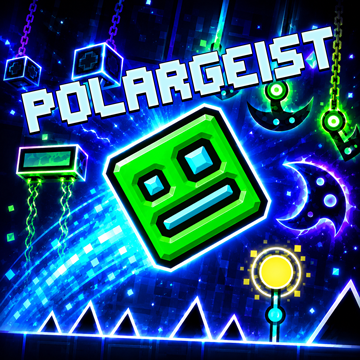
How to Play Geometry Dash Polargeist
- Click the left mouse button on a computer or tap the screen on a mobile device to make your character jump or control different game modes after passing through portals.
- During Practice Mode, press Z to place a checkpoint gem wherever you want to continue practicing. Press X to remove the most recently placed checkpoint if you want to adjust your training route.
A Beginner-Friendly Geometry Dash Experience
Geometry Dash Polargeist has remained popular for years because it offers an excellent balance between accessibility and challenge.
Slower Speed Makes Learning Easier
Compared with many later Geometry Dash levels, Geometry Dash Polargeist moves at a more comfortable pace.
The slower speed gives players extra time to recognize obstacles, prepare jumps, and understand how different mechanics work. Instead of overwhelming newcomers with constant high-speed sections, the level encourages steady improvement through repetition.
This pacing makes it much easier to develop confidence before moving on to more demanding stages.
Fewer Obstacles Than Advanced Levels
Another reason Geometry Dash Polargeist is suitable for beginners is its obstacle design.
The level contains fewer densely packed spike formations than harder entries in the series. Most jumps are clearly visible, giving players enough time to react and correct small mistakes.
While the level still requires concentration, it rarely feels unfair. Every obstacle teaches a useful lesson that prepares players for future challenges.
Practice Mode Helps You Improve Faster
Many new players underestimate how useful Practice Mode can be.
Checkpoint gems allow you to isolate difficult parts instead of replaying the entire level after every failure. Spending a few minutes practicing one troublesome section often saves much more time than repeatedly attempting full runs.
This learning process is one of the reasons Geometry Dash Polargeist remains one of the most recommended levels for beginners.
Ready for a Bigger Challenge?
After consistently completing Geometry Dash Polargeist, many players begin looking for more demanding levels.
Those interested in testing their skills against some of the toughest obstacle patterns can continue with Geometry Dash Demons, where tighter timings, faster gameplay, and much more complex layouts provide a completely different level of difficulty.
Essential Skills for Geometry Dash Polargeist
Although Geometry Dash Polargeist is beginner-friendly, improving your performance still requires several important skills.
Rhythm Recognition
Geometry Dash has always been built around music.
Instead of viewing the soundtrack as simple background audio, treat it as part of the gameplay. Many jumps naturally align with the beat, making it easier to predict when to jump.
Experienced players often rely on the music just as much as the visual obstacles.
Jump Timing
Perfect timing is more important than fast reactions.
Pressing too early or too late usually causes the same result - a collision with a spike. Learning exactly when to jump becomes much easier after repeating each section several times.
Avoid unnecessary extra clicks because they often disrupt your rhythm and lead to avoidable mistakes.
Reading the Level Ahead
New players frequently watch only their character.
A much better habit is looking slightly ahead so you can prepare for the next obstacle before reaching it. This small adjustment gives your brain more time to process upcoming jumps and creates smoother gameplay.
As levels become more difficult, reading ahead becomes one of the most valuable skills you can develop.
Flying Control
Although Geometry Dash Polargeist mainly focuses on jumping, it also introduces short flying sections.
These moments teach players how small adjustments affect movement in the air. Instead of making large corrections, use gentle taps to maintain stable control.
Building confidence during these early flying sequences makes later Wave-focused challenges feel much more manageable.
Consistency Over Speed
Many beginners rush through easy sections because they want to reach new parts quickly.
A better strategy is maintaining the same rhythm from beginning to end. Consistent movement produces fewer mistakes and helps build the muscle memory needed for harder Geometry Dash levels later.