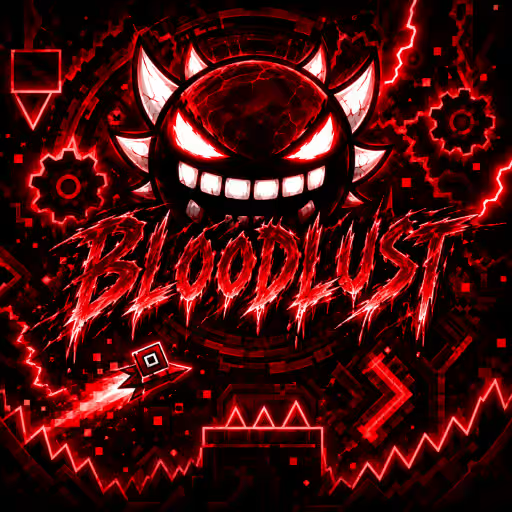
How to play Geometry Dash Bloodlust?
- Click the left mouse button, press the spacebar to jump or fly up.
- Press the Z key to place the checkpoints.
- Press the X key to delete the checkpoints.
Technical specifications and difficulty of Geometry Dash Bloodlust
Geometry Dash Bloodlust is famous not only because of its difficulty but also because of its scale and detailed design. It is an Extreme Demon created as a large collaboration involving multiple creators. The level was hosted by Manix648 and verified and published by knobbelboy. Its level ID is 42584142, and it uses Dimrain47's “At the Speed of Light” as its soundtrack.
What is the current Demonlist position of Bloodlust?
Bloodlust originally made history by entering the Demonlist at #1, making it the hardest level in the world at the time of its release. It remained at the top for more than a year before newer Extreme Demons pushed it downward.
Today, its position is much lower because the Geometry Dash community has produced many increasingly difficult levels. The current Pointercrate Demonlist focuses its active record system on the Top 150 and excludes legacy levels from record submissions. Bloodlust is therefore no longer an active Top 150 Demon.
For comparison, the AREDL page currently lists Bloodlust at #253. AREDL describes it as a legendary former Top 1 and highlights its fast-paced gameplay, chokepoints, ship sections, and nerve-control requirements.
This change does not mean that Bloodlust has become an easy level. It simply shows how dramatically the Geometry Dash difficulty standard has evolved. Levels that were considered almost impossible several years ago can eventually move down the rankings as stronger players and harder creations enter the scene.
Length and object count
Bloodlust is an XL level with a playtime of roughly 2 minutes and 50 seconds. Pointercrate lists the level at 2:51, while the Official Geometry Dash Wiki records it at approximately 2:50.
The level contains around 170,000 objects, not more than 350,000. Pointercrate currently lists 170,739 objects, while the Official Geometry Dash Wiki gives 170,743. The small difference comes from how different databases record the level data.
This huge object count contributes to the visual density of the level. Bloodlust contains detailed structures, effects, decorations, backgrounds, and gameplay objects that work together to create its distinctive appearance.
The connection between Geometry Dash Bloodlust and Bloodbath
One of the most important things to understand about Geometry Dash Bloodlust is its relationship with Geometry Dash Bloodbath, the legendary level created and published by Riot.
Bloodlust was designed as a buffed and extended remake of Bloodbath. It takes the original concept and pushes it further with additional gameplay, more demanding sections, and a heavily redesigned visual presentation. The AREDL description specifically identifies Bloodlust as a remake of Bloodbath that adds an approximately minute-long extension, changes existing gameplay, and introduces an overhauled visual style.
Bloodbath as the foundation
Bloodbath is one of the most recognizable Extreme Demon levels in Geometry Dash history. Riot hosted and verified the level, which was released in 2015. It became famous for its hell-themed presentation, tight gameplay, and enormous difficulty for its era.
Bloodbath itself is approximately 1 minute and 52 seconds long and contains around 24,746 objects, making Bloodlust substantially longer and more object-heavy.
The success of Bloodbath created the foundation for Bloodlust. Instead of simply copying the original level, the creators expanded its ideas and rebuilt many sections to create something that felt familiar while still presenting a much greater challenge.
A longer and more intense experience
The extended structure is one of the clearest differences between the two levels. Bloodlust adds new gameplay and extends the overall experience, turning the original Bloodbath concept into a significantly longer challenge.
The extra length also increases the importance of consistency. A player must survive not only the difficult sections inspired by Bloodbath but also the additional gameplay introduced in Bloodlust.
This makes the level particularly demanding during long attempts. Even if a player performs well during the first half, mistakes can still happen later because of fatigue, nerves, or a difficult transition.