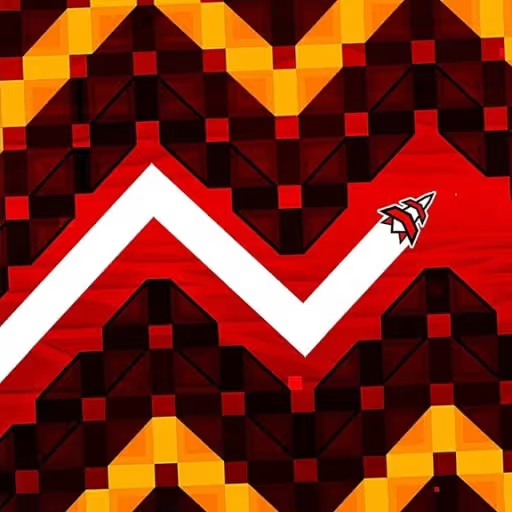
How to play Geometry Dash Nine Circles?
Basic controls
- Left Mouse Button: Click to control the character.
- Z: Press Z to place a checkpoint.
- X: Press X to delete a checkpoint.
Players who enjoy this type of reaction-based platforming may also like Geometry Vibes Monster, another fast-paced game where careful timing and quick movement are important. Its challenging obstacle sequences provide a different way to enjoy precision-based arcade gameplay.
Watch the obstacles carefully
Nine Circles contains many obstacles that require precise movement. Spikes, narrow passages, moving objects, and changing pathways can appear with little room for error.
Keep your attention on the upcoming section instead of focusing only on the character. Looking ahead gives you more time to prepare for a jump, change direction, or adjust your timing.
Your goal in the game
The main objective in Geometry Dash Nine Circles is to reach the end of the level and complete it. Reaching the finish requires you to pass through every obstacle section without making a fatal mistake.
The level can feel difficult because its challenge increases as you progress. Early sections give you opportunities to understand the movement, while later parts can demand much more precise timing.
Reach the finish line
Completing the level is your primary goal. Every successful section brings you closer to the end, but the level does not allow careless movement.
A failed attempt normally means restarting the challenge or returning to the relevant practice point. This makes repetition an important part of the experience. Each attempt gives you another opportunity to learn the timing of difficult sections.
Rather than treating failure as wasted progress, use every attempt to identify exactly where your timing went wrong. A jump that feels impossible at first can become much easier after several focused practice attempts.
Collect coins
Coins provide an additional objective for players who want to explore beyond simply reaching the end. They can be placed in areas that require more careful movement or a less direct route.
Collecting a coin may require you to change your usual strategy. You might need to enter a different path, adjust your timing, or take a greater risk around nearby obstacles.
For this reason, completing the level and collecting every coin can feel like two separate challenges. First, learn how to survive the main route. Once the basic path becomes familiar, return to difficult sections and work on the coin routes.
What forms does the main character have?
One of the most recognizable features of Geometry Dash gameplay is the ability to transform into different forms. Each form has its own movement style, which means you need to adjust your timing whenever the character changes.
Nine Circles-style gameplay can include several familiar Geometry Dash forms, such as the Cube, Ship, Ball, UFO, Wave, Robot, Spider, and Swing. These forms create variety throughout the level and prevent the gameplay from relying on one movement pattern.
Cube
The Cube is one of the most familiar forms. Its movement focuses heavily on jumping over obstacles and landing on platforms.
Timing is essential because spikes can be placed close together. A single early or late jump can cause a collision.
Ship
The Ship, sometimes described as the plane form, allows the character to fly through the level. Holding the control button moves the ship upward, while releasing it allows the ship to descend.
Ship sections often contain narrow corridors. Small changes in height can determine whether you safely pass through an opening or hit an obstacle.
UFO
The UFO offers a different style of aerial movement. Instead of continuous flight like the Ship, each click or press produces a distinct jump-like movement.
The spacing between obstacles determines how quickly you need to react. Learning the rhythm of repeated UFO movements can make difficult sections much more manageable.
Wave
The Wave is particularly important in Nine Circles-style gameplay. It moves diagonally upward or downward, creating a zigzag path through the level.
Wave sections often feature narrow corridors surrounded by spikes. Precise control is essential because even a small movement can change the entire trajectory.
Ball
The Ball form changes the way gravity works. Activating the control switches the character between the floor and ceiling.
This form requires players to think about gravity rather than traditional jumping. Watching the upcoming platforms makes it easier to anticipate when a gravity change will be useful.
Robot
The Robot resembles the Cube but offers more control over jump height. The longer you hold the button, the higher the jump can become.
This creates more flexibility, but it also means you need to control the duration of each input carefully.
Spider
The Spider can quickly switch between surfaces. Its movement is based on rapid teleport-like changes between the floor and ceiling.
Spider sections can look confusing at first, especially when obstacles are positioned close together. Learning the exact timing of each switch makes these sections easier to handle.
Swing
The Swing is another aerial form based on directional movement. It can change its trajectory depending on your input, making control and timing especially important.
Like the Wave and Ship, the Swing becomes more difficult when the available space is limited.